
How Much Lid Clearance Does a Top-Load Washer Need?
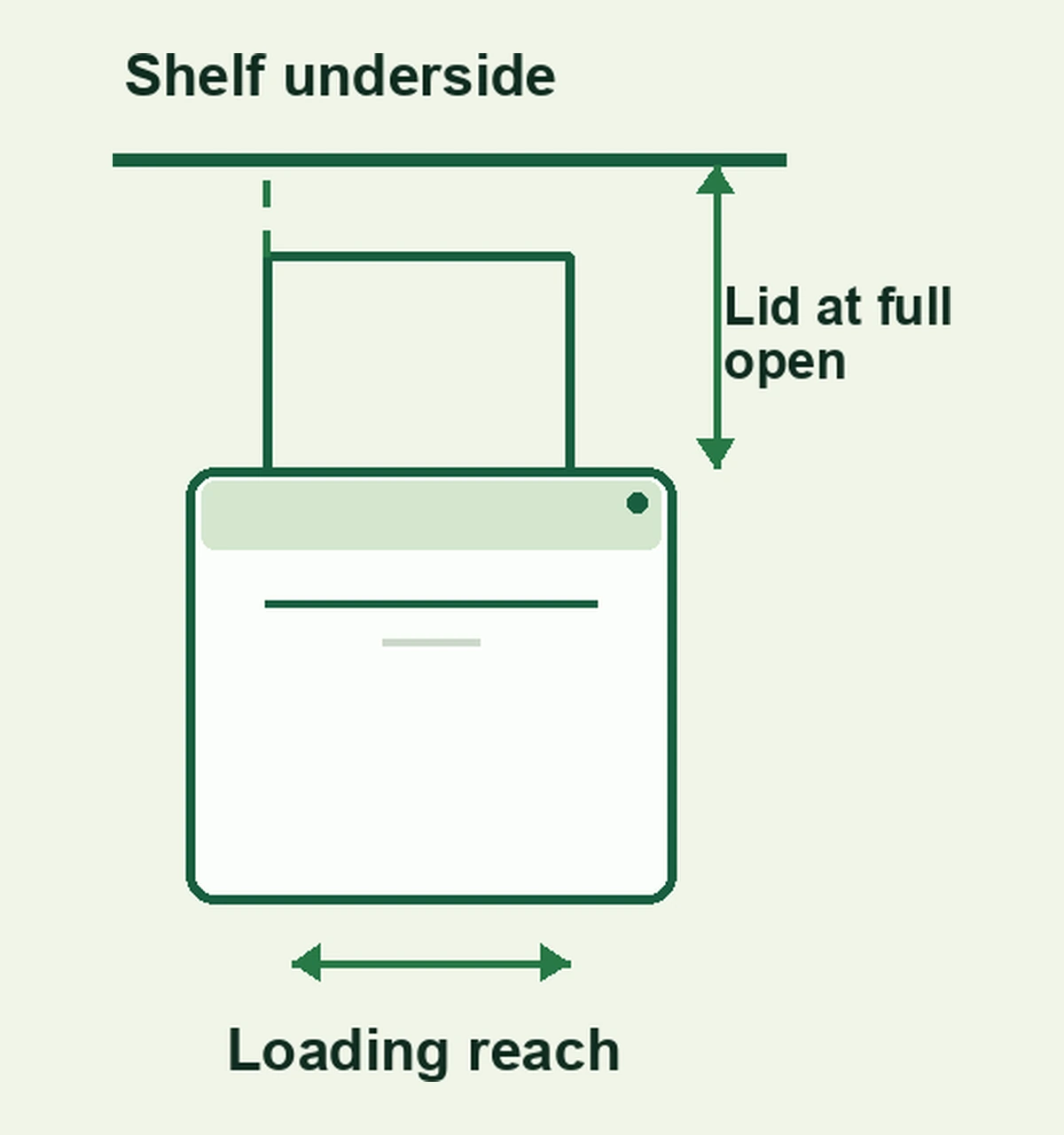
Measure a top-load washer’s clearance using its documented height with the lid fully open and the height of the lowest shelf or cabinet in the laundry space. Check where the lid swings and whether you can comfortably reach into the drum. Compare the exact model’s dimensions with your measurements.
| Check | What to verify |
|---|---|
Closed height | Record cabinet height |
Open height | Check the manufacturer drawing |
Reach | Check shelf and door positions |
Model-Specific Lid Height: Why It Matters
Each top-load washer has a different lid height when open. Some lids stand nearly vertical, while others tilt at a slight angle or extend backward. The open-lid height is the distance from the floor to the highest point of the lid when fully open. This is often several inches or more above the top edge of the closed washer.
For example, one washer might be 43 inches tall with the lid closed, but 57 inches tall with the lid open. Another model could have a different open-lid height even if its closed height is the same. This variation makes model-specific measurements necessary. Never assume a washer will fit under a shelf or inside a closet just because a previous one did.
Robust Rentals lists washers individually. Always ask for the open-lid height for the exact model you want to rent. You can also request a photo or diagram showing the lid open, if available. This helps avoid surprises when the washer is delivered to your Kansas City address.
Shelf and Cabinet Interference
Laundry closets often have a shelf or cabinet above the washer area. This shelf can block the washer lid from opening fully, making it hard to load or unload laundry. The gap between the top of the washer and the bottom of the shelf is critical.
If the shelf is too low, you may only be able to open the lid partway. That makes reaching the drum difficult and can force you to load laundry at an awkward angle. In some cases, the lid may not clear the shelf at all, preventing you from using the washer.
To check for interference, measure the vertical space from the floor to the underside of the shelf or cabinet. Compare this to the washer’s open-lid height. If the shelf is lower than the open lid, the lid will hit the shelf before it’s fully open.
Some renters in Kansas City apartments find they must remove or adjust a closet shelf before installing a top-load washer. If you cannot remove the shelf, consider a front-load washer or check if Robust Rentals can suggest a compatible top-load model with a lower open-lid height.
Reaching the Drum: Ergonomics and Access
Even if the lid opens partway, you need enough clearance to reach the drum comfortably. Many top-load washers have deep tubs, requiring you to lean in. If the lid cannot open fully, your reach will be restricted, especially for shorter users or for those with mobility concerns.
Try to allow enough space so the lid opens at least 70 to 80 degrees, not just a narrow slot. A partially blocked lid can also cause wear on the hinges or damage to the finish over time. If you store detergent or laundry baskets on the shelf above, remove them before measuring, since these items can also interfere with the lid.
If you have physical limitations, measure how far you can reach into the drum with the lid open to the available angle. Some Kansas City renters use a step stool, but this is not recommended for regular laundry use due to safety risks. Instead, focus on finding a washer that fits your space and allows safe, comfortable access.
Service Clearance and Lid Geometry
Top-load washer clearance in a laundry closet is not just about the lid. Service clearance, the extra space needed for maintenance, repairs, or moving the washer, is important. Some washers require the lid to open further for service access, or for removing and replacing internal parts.
Lid geometry also affects clearance. A lid that opens straight up may need less depth behind the washer, while a lid that tilts backward could require several extra inches between the washer and the wall or shelf. Some lids are curved or have protruding handles that add to the open height.
When you rent from Robust Rentals, you do not own the washer, so covered service is included. If a technician needs to access the inside of the machine, a fully blocked lid or tight closet can make repairs difficult or delay service. Ask Robust if your planned closet has enough room for both regular use and service visits.
If you plan to install a dryer side-by-side, check both appliances’ service clearances. Sometimes, a closet that fits two closed machines will be cramped once the washer lid is open and the dryer door is swung out. Measure carefully and ask for both open dimensions.
Quick Clearance Checklist
- Measure floor to shelf or cabinet bottom.
- Get the open-lid height for your washer model.
- Check for any handles, curves, or protrusions on the lid.
- Confirm extra clearance for service (ask Robust if unsure).
- Consider obstacles: detergent bottles, baskets, lighting fixtures.
- If installing a set, check both washer and dryer clearances.
Measurement Example Hypothetical Kansas City Laundry Closet
Suppose your apartment closet floor to shelf is 55 inches. You’re considering a washer from Robust Rentals, which tells you (hypothetically) that the open-lid height for your model is 57 inches. Here’s how you’d reason through the fit:
- The open lid would hit the shelf, since 55 inches is less than 57 inches.
- The lid would not open fully, blocking access to the drum.
- Service technicians may have trouble performing repairs.
- You could not load or unload laundry easily, especially bulky items.
In this hypothetical scenario, you would need to either:
- Ask management about the shelf. Compare any approved change with the open-lid height listed for the hypothetical model.
- Select a different washer with a lower open-lid height, if Robust offers one.
- Consider a front-load washer, which opens from the front and does not require overhead clearance.
When measuring, use a tape measure from the floor to the lowest point of the shelf or obstruction. Write down the measurement and compare it to the washer’s open-lid height as listed by Robust. If there’s any doubt, ask for help or request a site check before delivery.
Practical Worksheet for Clearance Planning
Use this worksheet to plan your top load washer clearance in your laundry closet:
- Floor to shelf/cabinet height: ______ inches
- Washer closed height (from Robust): ______ inches
- Washer open-lid height (from Robust): ______ inches
- Difference (shelf height minus open-lid height): ______ inches
- Lid geometry (vertical, angled, curved): ___________________
- Potential obstacles (list): _______________________________
- Extra clearance for service: Yes / No / Unsure (ask Robust)
- Notes for delivery or installation team: ___________________
Fill in this worksheet before finalizing your rental. If your “difference” is negative, the lid will not open fully. If it’s close to zero, consider extra clearance for comfort and service.
The rest of the article continues with additional sections on delivery logistics, communicating with your rental provider, and tips for maximizing small laundry closet spaces.
When Your Laundry Closet Has Built-Ins, Doors, or Tight Sides
Many Kansas City laundry closets come with built-in shelving, cabinets above, or even bi-fold or sliding doors that can complicate top load washer clearance. These features affect both how much you can open the lid and how easily you can access the drum. Here’s how to approach these nuanced scenarios so you don’t discover a problem after delivery.
Overhead Cabinets and Shelves
Overhead shelves or cabinets directly above the washer often block the lid from opening fully. Some models require the lid to open nearly vertical (about 90°) to stay up, while others may stay open at a slight angle. Even a few inches of overhang can force you to prop the lid open with your hand or body, making it harder to load bulky items or remove laundry.
What to do: Measure the vertical space from the top of your washer (not the floor) to the bottom of any shelf or cabinet. Then, check the washer’s manual or ask Robust for the model’s “height with lid open.” If the space is less than that, expect partial opening only. For example, if you have 49 inches from the washer top to a shelf, but the washer needs 54 inches with the lid open, you’ll only get about 70–80° of opening. This might work for small loads, but large comforters or reaching the far side of the drum can be awkward.
Side Walls and Narrow Spaces
Laundry closets with walls or cabinetry tight to the washer’s sides can limit how far you can shift the machine for service or cleaning. Some top load washers have wide, overhanging lids or control panels that require extra side clearance to open fully. If the closet is barely wider than the washer itself, the lid or controls may bump the wall before opening all the way.
What to do: Before committing to a washer, measure the closet’s width at the narrowest point. Compare this to the overall width of the washer plus any side-to-side lid movement (some lids are offset). Leave at least a couple of fingers’ width on each side for airflow and to avoid scraping paint or trim.
Door Styles: Bi-Fold, Sliding, or Outward Swing
Closet doors can interfere with both washer delivery and daily use. Bi-fold and sliding doors often reduce the opening width, so even if the closet is deep enough, you may not be able to angle the washer in or open the lid easily. Outward-swinging doors might block the path to the washer or make it hard to stand in front of the drum.
What to do: Stand where you would load the washer and open the closet doors as you normally would. Check where the center of the lid will swing and how much room your arms and basket need. Ask management before changing any doors or shelves.
Low Ceilings and Sloped Attic Spaces
If your laundry closet is in a finished attic or basement with a sloped ceiling, the height above the washer can change drastically from front to back. The lid might open fully only if the washer is pulled forward, which may not be possible once hooked up.
What to do: Measure at the deepest part of the closet and again at the front edge. If the washer has to sit all the way back, check if the lid hits the ceiling before reaching its open position. If so, partial opening is the reality, factor this in for day-to-day use.
Clearance Planning Worksheet: Step-by-Step Example
The following worksheet will help you map out your laundry closet and check top load washer clearance in detail. This is especially useful for renters or homeowners in Kansas City apartments, condos, or older houses with quirky layouts.
Hypothetical Example: Imagine you’re moving into a Midtown Kansas City apartment with a closet that measures 31 inches wide, 30 inches deep, and 76 inches high (from floor to ceiling). There’s a shelf 50 inches above the floor, and bi-fold doors that fold to the sides.
Step 1: Measure Each Critical Dimension
- Width (side to side): 31 inches
- Depth (front to back): 30 inches
- Height to shelf: 50 inches
- Height to ceiling: 76 inches
- Door opening width: 28 inches (bi-fold doors)
Step 2: Review Model-Specific Washer Dimensions
Suppose you’re considering a Robust Rentals washer with the following (hypothetical) specs:
- Washer width: 27 inches
- Washer depth: 27 inches
- Washer height: 43 inches
- Height with lid open: 54 inches
- Lid geometry: Lid hinges at the back, opens straight up
Step 3: Check for Interference
- Width: 31 in closet – 27 in washer = 4 inches leftover (2 inches clearance per side)
- Depth: 30 in closet – 27 in washer = 3 inches leftover (room for hoses and airflow)
- Height to shelf: 50 in (from floor) – 43 in (washer height) = 7 inches above washer
- Height with lid open: 54 in needed, but shelf is only 7 in above washer, so lid will hit the shelf after opening about 7 inches
- Result: Lid will only open about 30–40°, not fully vertical
Step 4: Plan for Use
- Loading and unloading: Partial lid opening may be fine for small loads but is awkward for bedding or reaching the far side of the drum
- Service access: There’s enough space to slide the washer forward a few inches if necessary, but hoses and cords may limit this
- Door access: The 28-inch door opening is enough for a 27-inch washer, but only if the doors are fully folded back during delivery
Step 5: Take Action
- Options:
- Remove or raise the shelf to allow full lid opening
- Accept partial lid opening and adjust laundry habits
- Confirm with Robust that the specific washer model will fit and function in this setup
- If possible, request a model with a shorter lid or different hinge geometry
Always confirm the actual model’s specs and the installation plan with Robust Rentals before finalizing your order.
Unusual Scenarios: What If My Closet Is Really Awkward?
Extra-Deep Closets
Some closets are much deeper than the washer, leaving a large gap at the back. This can tempt users to push the washer all the way back, but this may make it hard to reach the drum or connect hoses. In these cases, it’s often best to leave the washer closer to the front, even if it means losing some floor space in the closet.
Split-Level or Step-Up Laundry Nooks
If your washer sits on a raised platform or step, this changes the height you need for lid clearance. Measure from the top of the platform, not the floor, and be aware that raising the washer can make it harder for shorter users to reach the bottom of the drum.
Utility Closets Shared With Water Heaters or HVAC
Shared spaces may have pipes, vents, or ducts overhead or behind the washer. These can block the lid or make service access much harder. Always check for obstructions above and behind, not just in front or to the sides.
Rental Restrictions on Modifying Closets
In many Kansas City rentals, you can’t remove shelves or modify closet doors without written permission. If you can’t alter the space, you’ll need to choose a washer that fits the existing setup or accept the limits of partial lid opening.
FAQs: Top Load Washer Clearance in a Laundry Closet
What if my shelf or cabinet blocks the lid from opening all the way?
You can still use the washer if the lid opens partway, but it may be harder to load large items or reach the far side of the drum. Some models require the lid to be fully open for certain cycles or for the washer to run. Always check the manual or ask Robust for guidance.
Can I remove the closet doors to make space for delivery or use?
In most Kansas City rentals, you can temporarily remove closet doors, but check your lease or ask your landlord first. Make sure doors are stored safely and reinstalled at move-out.
Does partial lid opening affect washer performance?
Usually, the washer will still operate, but you may find it less convenient for bulky loads or cleaning the drum. Some models have lid locks or sensors that require full opening for certain functions, always confirm with Robust or check the manual.
How do I know if a Robust Rentals washer will fit my closet?
Measure your closet’s width, depth, and height to all obstructions. Provide these measurements to Robust Rentals and ask for the model’s dimensions, including height with lid open. Robust can confirm compatibility before delivery.
What if I need to move the washer for service?
Most laundry closets need a few inches of clearance on each side and behind the washer for service access. If the closet is extremely tight, Robust service may require you to temporarily move the washer out. Always plan for how the washer can be accessed if repairs are needed.
Confirm Your Fit With Robust Rentals
Now that you know how to plan for top load washer clearance in your laundry closet, gather your closet’s measurements and note any shelves, cabinets, or door styles that could interfere. Contact Robust Rentals with your measurements and ask for the model’s “height with lid open” and service clearance needs. This way, you can be confident your washer will fit and work for your space, before you schedule delivery.
Rental options and related guides
See current washer and dryer rental options
Measure the laundry closet and delivery route · Check apartment washer and dryer hookups