
Can You Stack Any Washer and Dryer Together?
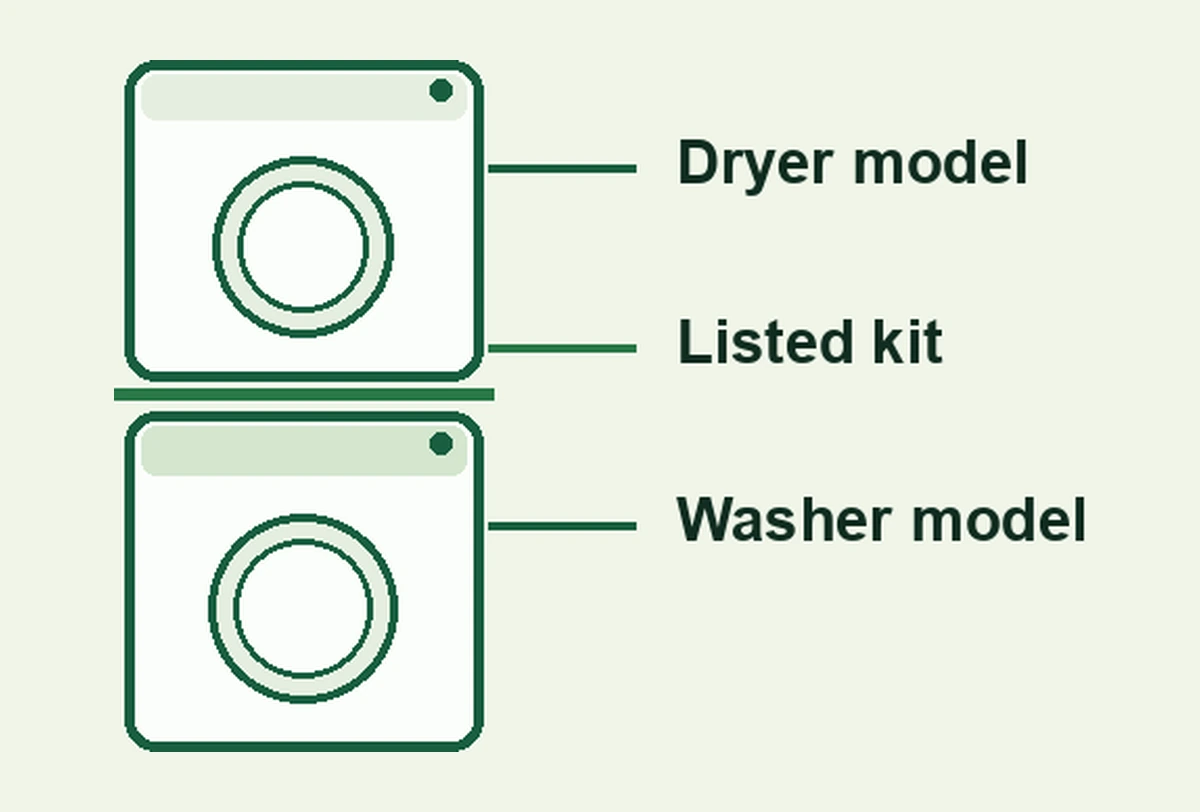
No. Stack a washer and dryer only when the manufacturer lists your exact model combination and specifies an approved stacking kit or integrated configuration. Confirm the installation requirements in the model documentation and use qualified assistance. Two matching widths or a shared brand name cannot establish compatibility.
| Check | What to verify |
|---|---|
Model labels | Write down both numbers |
Compatibility | Confirm manufacturer listing |
Installation | Use approved parts and help |
Stacking Basics: What Compatibility Really Means
Stacking a washer and dryer is only possible if both units are designed for it. This is not simply a matter of physically fitting one on top of the other. Manufacturers engineer certain front-load washers and matching dryers to be safely stacked using an approved kit. The kit secures the dryer to the washer, preventing movement and reducing the risk of tipping.
Model documentation will state if stacking is supported. Even among models from the same brand, not all pairs are stackable. For example, a top-load washer is never stackable. Some front-load washers and dryers from the same brand or similar appearance may not be compatible due to differences in weight distribution, controls, or dimensions.
You must always check the official manual or specification sheet for both machines. Do not assume stackability based on looks, brand, or sales listing. If you are renting from Robust Rentals, confirm model compatibility with them before requesting a stackable setup.
Why You Can’t Mix and Match Most Washers and Dryers
Most washers and dryers are not designed to be stacked with any other model. Even if two machines look similar in size or style, their designs may not line up for safe stacking. Here are some reasons:
- Mounting Points: Stacking kits are tailored to fit the mounting points and contours of specific washer and dryer models. Using a kit with the wrong machines can fail to secure the dryer, risking vibration or falling.
- Weight and Balance: Washers are much heavier, especially when filled with water. They must be on the bottom. Not all dryers are designed to rest safely on top of all washers.
- Controls and Access: Some dryers have controls on the top panel, which would be inaccessible in a stacked setup. The door swing direction and handle height may also cause issues.
- Vibration and Movement: Mismatched machines may vibrate excessively or shift, leading to noise, damage, or unsafe conditions.
If you rent appliances individually, there is no guarantee they can be stacked. Even if a stacking kit is available, it must be the exact one specified for those models. Never improvise or use a generic kit. This can void service coverage or cause damage.
Real-World Mismatch Scenarios
Imagine a renter in a Kansas City apartment with a laundry closet just big enough for a stacked pair. They rent a refurbished washer and a separate dryer from Robust Rentals. If these two machines are not specifically matched for stacking, several problems can occur:
- The stacking kit does not fit, or the mounting holes do not align.
- The dryer’s controls are blocked by the washer’s top edge.
- The machines are different depths, causing the dryer to hang over the edge.
- The washer vibrates during spin cycles, shifting the dryer and risking falls.
Even if the machines fit in the space, these issues mean they cannot be stacked safely or at all. In these cases, Robust Rentals will not stack the pair and will recommend a side-by-side setup instead. If you have a specific space or closet, always provide the exact dimensions and ask about stackable options before renting.
Confirming Stackable Compatibility: Steps and Evidence
To determine if you can stack any washer and dryer together, follow these concrete steps:
- Check the Model Numbers: Find the exact model numbers of both the washer and the dryer. These are usually on the door frame or back panel.
- Read Both Manuals: Look for a stacking section in each manual. It should specify if stacking is supported and list compatible models.
- Confirm the Stacking Kit: The manual will list a specific stacking kit model number. Only use this kit.
- Check with the Provider: If renting, ask Robust Rentals to confirm whether your selected washer and dryer can be stacked, based on their documentation.
- Do Not Substitute Kits: Never try to use a kit not listed for both appliances. Do not attempt to stack without a kit.
- Plan for Access: Make sure the stacked height will not block doors, cabinets, or light fixtures.
Checklist for Stackable Laundry:
- Are both machines front-load models?
- Do both manuals list stacking as an option?
- Is there a matching stacking kit for both?
- Will the stacked height fit your space?
- Has Robust Rentals confirmed compatibility?
If any answer is "no," stacking is not possible with those machines.
Side-by-Side as the Practical Alternative
When stacking is not an option, a side-by-side setup is the default. Most standard washers and dryers are designed to sit next to each other. This setup avoids all stacking compatibility problems. You do not need matching models to use machines side by side, as long as each fits your space and hookups.
Side-by-side arrangements also make it easier to access the tops for folding or storing laundry supplies. Controls are always within reach. If your laundry room, basement, or closet has enough width, this option is usually simpler and less restrictive.
For renters in Kansas City apartments or older homes, side-by-side may be the only choice if the laundry area is wider than it is tall, or if the machines rented from Robust Rentals are not a designated stackable pair. If you need the machines placed side by side, confirm the available width and depth with Robust Rentals before delivery.
Labeled Example Matching Stackable Pair Decision
Example: A renter in a Plaza-area apartment wants to maximize a small laundry closet by stacking. They see two white front-load machines listed by Robust Rentals. Each is available separately or as part of a side-by-side set. The renter wants to know if they can stack any washer and dryer together from this listing.
Steps and Reasoning:
- Model Numbers: The renter asks Robust Rentals for the exact model numbers of the available washer and dryer.
- Manual Review: They check the online manuals for both models. The washer’s manual lists stacking as an option and specifies compatible dryer models and a required stacking kit. The dryer’s manual also lists stacking, with the same kit and matching washer model.
- Kit Confirmation: The renter asks Robust Rentals if the recommended stacking kit is available and included.
- Space Check: The renter measures their closet height and confirms with Robust Rentals that the total stacked height will fit.
- Decision: Because both models and the kit are compatible, stacking is approved by Robust Rentals. If any of these steps had failed, such as mismatched model numbers, missing stacking instructions, or unavailable kit, stacking would not be allowed, and side-by-side would be the only option.
This example shows that stacking is only possible with confirmed, matching models and the correct kit. It is not safe or allowed to stack any random washer and dryer, even if they are both front-load and appear similar.
What Can Go Wrong: Safety and Service Issues
Attempting to stack incompatible machines can lead to several problems:
- Safety Hazards: An unsecured dryer can fall during use, causing injury or damage.
- Service Refusal: Robust Rentals will not service or support machines installed in a non-approved stacked configuration.
- Damage to Machines: Improper stacking can damage the control panels, doors, or internal components of both appliances.
- Noise and Vibration: Unmatched machines often vibrate excessively, leading to loud operation and possible movement.
If you try to stack without manufacturer approval, you risk losing included service coverage. Always follow the steps above and use qualified help for setup. If you are unsure, ask Robust Rentals for documentation or assistance.
Making the Choice: Rental Logistics and Space Planning
If you are renting in Kansas City or a nearby suburb, consider these planning tips:
- Measure Carefully: Know the width, depth, and height of your laundry area. Stacked units are taller but take less floor space.
- List Your Priorities: If space is tight, stacking may be essential. If you want folding space or easy access, side-by-side may be preferable.
- Ask for Options: Robust Rentals can clarify which models are stackable or only side-by-side. Their written quote will include terms and fees for your situation.
- Utility Hookups: Ensure existing hookups are compatible before delivery. Robust Rentals requires existing, compatible hookups for installation.
In Kansas City, many apartments and older homes have limited laundry space. Stacking can be a good solution, but only when the machines and kit are a tested match. If not, side-by-side is safer and more flexible.
Nuanced Scenarios: When Stacking Isn’t Possible or Practical
Even if you’ve checked the basics, some situations make stacking a washer and dryer impossible or unwise. These nuanced scenarios often come up in Kansas City apartments, rental homes, or older properties where existing setups or rules limit your options. Understanding these less obvious barriers can help you avoid frustration and make better use of your space and rental budget.
Scenario 1: Units Look Similar but Aren’t Designed to Stack
Some washers and dryers are similar in size, color, and appearance, especially when offered as “matching” sets by a rental company. This does not mean they are stackable. Stackable pairs are always engineered with specific hardware, reinforced cabinetry, and compatible controls. If you see two machines that look alike but do not have an approved stacking kit listed in both their manuals, assume they cannot be safely stacked. Attempting to stack incompatible machines, even temporarily, risks tipping, vibration damage, and voided service coverage.
Scenario 2: Conflicting Controls or Door Swings
Stackable pairs are designed so that both machines’ doors, drawers, and controls remain accessible when stacked. If a washer’s detergent drawer or a dryer’s door would be blocked by stacking, or if controls are out of reach, stacking is not feasible, even if the machines are technically “stackable.” Always check the manuals for both models, and if possible, inspect the machines in person or ask for detailed measurements and door swing diagrams.
Scenario 3: Stacking in Small or Shared Laundry Spaces
Kansas City renters often share laundry areas or have compact utility closets. Even with stackable models, there must be enough room for airflow, hookups, and safe operation. If your laundry nook is too shallow or narrow, stacking may block vents, doors, or access panels. In multi-unit buildings, building rules or shared utility access may further limit how and where you can stack. In these cases, side-by-side placement or using a laundry center may be the only practical options.
Scenario 4: Service and Access Complications
Stacked machines are harder to service, especially when repairs or filter cleanings are needed. If your rental includes covered service (as with Robust Rentals), make sure that the machines’ placement allows a technician to reach all panels and connections. If a stacked setup would block access to water shutoffs, electrical panels, or utility meters, your property manager or service provider may require a side-by-side arrangement or deny service until access is restored.
Worked Example Compatibility Worksheet for Renters
Stacking laundry machines in a Kansas City rental can be a smart space saver, but only if you confirm full compatibility. Here’s a practical worksheet that walks through each step, using a hypothetical example. Substitute your own details as you go.
Step 1: Gather Model Numbers
Write down the exact model numbers from the rental listing or the machines themselves. For example:
- Washer: Model XWM1234
- Dryer: Model XDM5678
Step 2: Find the Manuals
Search for the official user manuals online. Most manufacturers host free PDFs on their websites. If you rent from Robust, ask their team for digital copies.
Step 3: Look for Stack Kit Listings
In each manual, search for a section titled “Accessories,” “Installation,” or “Stacking.” Find the stack kit part number approved for your washer and see if the same kit and model number is listed for your dryer. If both manuals specify the same kit and confirm each model is stackable with the other, you have evidence of compatibility.
Example outcome:
- Washer manual: “Stack kit SK-100, for use only with dryers XDM5678, XDM5679.”
- Dryer manual: “Stack kit SK-100, for use only with washers XWM1234, XWM1235.”
- Both models list each other and the same kit. This is a compatible stackable pair.
Step 4: Check for Space and Access
Measure your laundry space. Compare the stacked height and width from the manuals (never guess or use averages). Confirm that doors, drawers, and controls will be accessible. If you need help, ask your rental provider for a site check or measurements.
Step 5: Confirm with Your Rental Provider
Before you sign up, send your compatibility findings to Robust or your rental company. Ask them to confirm the models, stack kit, and installation feasibility for your address.
Worksheet summary: If any step is uncertain, such as missing model numbers, unclear stack kit listings, or unmeasured space, do not proceed with stacking. Choose side-by-side placement or ask for an alternative set.
Special Situations: Addressing Common Rental Challenges
Apartment Laundry Closets
Many Kansas City apartments have laundry closets with bi-fold doors or limited depth. Even stackable pairs may not fit with the doors closed, or may block access to shutoff valves. Before renting, measure your closet’s width, depth, and height. Share these dimensions with your rental provider and ask if their machines will fit stacked, or if side-by-side is the only option.
Multi-Floor Buildings With Shared Utilities
If you live in a building with shared water or venting, property rules may limit which machines you can use and how they’re installed. Always check with your landlord or building manager before requesting a stacked setup.
Older Homes With Tight Hallways
Some older Kansas City homes have narrow hallways or doorways leading to the laundry area. Even if the machines are stackable and fit in the space, you may not be able to move them in or out without disassembly. Discuss delivery access with your rental company in advance.
Unusual Hookup Locations
Washer and dryer hookups sometimes appear on opposite sides of a room or at different heights. In these cases, stacking usually isn’t possible, regardless of model compatibility. Ask your rental provider to check hookups before scheduling delivery.
FAQs: Quick Answers to Common Stacking Questions
Can you stack any washer and dryer together if they’re the same brand?
No. Machines must be specifically designed and approved to stack with each other, even within the same brand. Always check both manuals for compatible stack kits and model numbers.
What happens if you try to stack mismatched machines?
Stacking incompatible machines can cause tipping, vibration, or damage. Service coverage may be denied if the setup is unsafe or not manufacturer-approved. Never improvise with off-brand kits or hardware.
Is it possible to rent a stackable washer and dryer set in Kansas City?
Yes, but only if the provider offers a matched, stackable pair and confirms compatibility for your space and hookups. Robust Rentals can help you verify options for your address.
Can I convert a side-by-side set to a stacked arrangement later?
Only if both machines are stackable with each other and you have the correct kit and space. Confirm with your rental provider before making any changes, as service access and covered installation may be affected.
What’s the best alternative if stacking isn’t possible?
Side-by-side placement is the safest and most flexible option for most renters. It allows easy access for service, cleaning, and daily use, and fits nearly all standard laundry hookups.
Confirm Your Model Compatibility Before Renting
Before you decide how to arrange your laundry machines, gather the exact model numbers and ask your rental provider (such as Robust Rentals) to confirm stackable compatibility. Request the manuals and stack kit details in writing, and measure your available space. Only proceed with a stacked setup if every step checks out, otherwise, side-by-side placement is the recommended, hassle-free alternative for Kansas City renters and homeowners.
Rental options and related guides
See current washer and dryer rental options
Measure the laundry closet and delivery route · Check apartment washer and dryer hookups
Sources and installation references
- GE Appliances guidance on model compatibility and stacking
- GE Appliances guidance on model-specific dryer clearances