
How Much Space Do You Need Behind a Washer and Dryer?
Use the installation drawings for your exact washer and dryer to determine the space needed behind them. Water hoses, drain lines, cords, and a vent if required can change the installed depth. Measure to the actual closet door or front obstruction, and tell the installer where connections stick out from the wall.
Clearance behind the machines is not the same as the overall closet or laundry room fit. It’s about the space just between the back of the appliance and the wall, including room for hoses, vents, and electrical cords. This guide helps you measure, plan, and avoid common mistakes, without modifying plumbing, electrical, or venting.
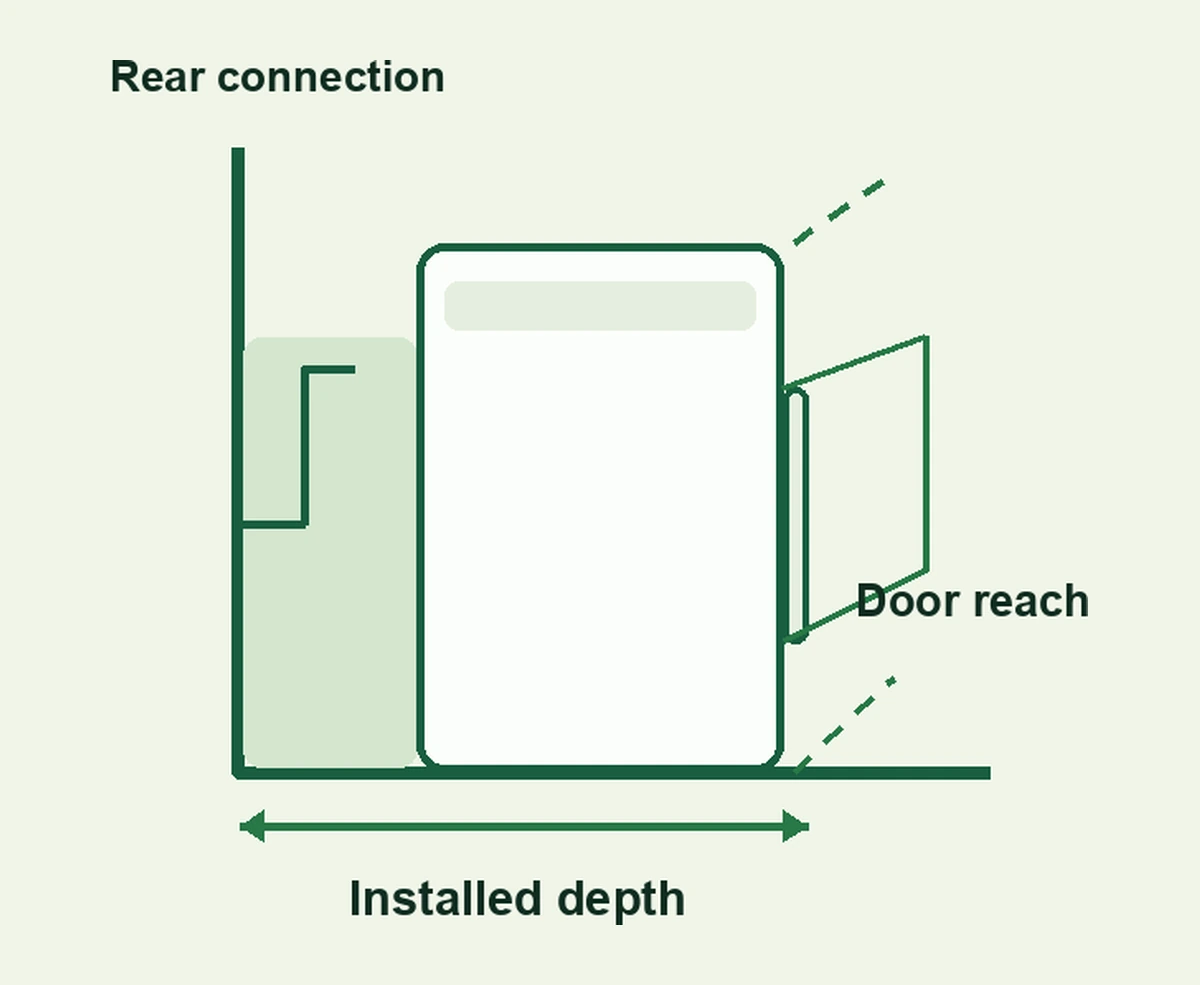
| Check | What to verify |
|---|---|
Map the wall | Record the outlets and connections |
Check depth | Include protrusions behind units |
Verify fit | Use both installation manuals |
Why Rear Clearance Matters for Washers and Dryers
Rear clearance is not just about sliding machines into place. The space behind a washer or dryer must safely fit hoses and vents, which often stick out more than the appliance body. If you ignore these needs, you risk kinked hoses, blocked vents, noise, leaks, or even damage to your unit or home.
Some washers and dryers look shallow but have control panels, handles, or rear panels that protrude. Others have nearly flush backs. The only way to know how much space you need is to check the exact model’s installation instructions or ask your rental provider. Robust Rentals can confirm if your hookups and space are compatible with the model you want.
Rear clearance is especially important in apartments, closets, and tight laundry nooks, where every inch counts. A machine that fits side-to-side may still stick out too far or crush its hoses in back.
Measuring the Rear Space You Need
Start by measuring from the wall to the edge of your available laundry area. Do not include trim, baseboards, or shelves in your measurement, measure the true flat wall. Then, check for any obstructions like pipes, outlets, or vents that stick out and reduce usable space.
Step-by-step measuring checklist
- Measure the depth of your laundry nook or closet from the wall to the edge.
- Look for any pipes, gas valves, or outlet boxes that protrude.
- Compare your measurement to the depth of the washer or dryer plus the required clearance for hoses and venting.
- Note if the machines will sit flush with the front of the closet, or if doors or trim will reduce usable space.
- Take photos of the space, including outlets and hookups, if you’re asking a rental company for advice.
Keep in mind that the washer dryer clearance behind is not just a set number. It depends on the hose style, vent type, and how far those connections stick out from the back of the machine. Some hoses curve gently and need more room, while others have tight elbows.
How Protrusions Change What Fits
Every model is different. Some washers and dryers have rear control panels, large access panels, or molded backs that add to their depth. Even two machines with the same “depth” on paper may not line up the same way in your space.
Common rear protrusions
- Water inlets: Most washers have water hoses that attach at the back and may stick out several inches. Some have side inlets, which can save space.
- Drain hoses: These may be rigid or flexible, and need enough room for the curve so they do not kink.
- Dryer vents: Rigid metal vents need more space than flexible ducts, and some models have vent outlets that angle up, down, or sideways.
- Power cords: Some power cords exit straight out, others to the side.
- Control panels: Some rear panels or knobs add an inch or two to the back.
Take photos of your hookups and the back wall before renting. If you’re in a Kansas City apartment, check if there’s a vent box or recessed connection panel in the wall. These can let the machine sit closer, but only if your model and hoses are compatible.
Planning for Laundry Hoses and Dryer Venting
Washer hoses and dryer vents are the main reason you need extra clearance. You cannot crush or sharply bend these connections without risking leaks or fire hazards. The safest setup is always one that leaves a gentle curve in hoses and a straight, unobstructed dryer vent.
Washer hose clearance
- Hoses: Use the washer installation guide to see the space and position it calls for around the supply and drain connections.
- Special hoses: Some “zero-clearance” or right-angle hoses can save space, but only use them if they’re approved for your model and hookups.
- Drain hoses: Allow room for the drain hose to curve gently into the standpipe or drain box.
Dryer vent clearance
- Rigid venting: Metal ducts need a straight path and extra room for elbows.
- Flexible venting: These can bend tighter, but are not always allowed and may trap lint.
- Wall vent box: If your laundry area has a recessed vent box, you may be able to push the dryer closer to the wall, but only if the dryer’s vent outlet lines up.
Never force a machine back against the wall. If you’re renting, Robust Rentals recommends using only the hoses and venting approved for your setup. If you’re unsure, ask for help from a qualified installer or your rental company.
Distinguishing Rear Clearance from Closet or Room Fit
It’s a common mistake to measure only the closet or laundry room’s total depth and assume your machines will fit. The total depth tells you if the machines will go into the space, but the washer dryer clearance behind determines if you can actually hook them up and use them safely.
For example, if your laundry closet is 33 inches deep and the washer is 29 inches deep, you might think you have 4 inches to spare. But if your water valves and hoses stick out 3 more inches, and the washer’s back panel protrudes 1 inch, you may have no room left for the washer to sit flush or for the door to close.
What to check besides rear clearance
- Front clearance: Will the doors open fully? Do you have room to load and unload laundry?
- Side clearance: Are there closet walls, shelves, or door frames that reduce usable width?
- Top clearance: If the machines are in a closet, will the doors close over them?
- Flooring and thresholds: Raised floors or thresholds can tilt machines forward or backward, changing how they sit.
Always use the specific model’s installation guide to check minimum clearances. If you’re renting, ask Robust Rentals to confirm if your space and hookups are compatible. Take measurements and photos so you have the details ready.
Example Planning Rear Clearance in a Kansas City Apartment
Suppose you’re renting a side-by-side washer and dryer for a typical Kansas City apartment laundry closet. The closet is 36 inches deep from the back wall to the closet doors.
You contact Robust Rentals, who lists a washer and dryer set. You ask for the installation dimensions, but since the exact model may vary, you get these hypothetical numbers for planning:
- Each machine is about 28 inches deep (not including hoses or protrusions).
- The water valves and drain box are surface-mounted, sticking out 2 inches.
- The washer hoses and dryer vent need a total of 5 inches for a gentle bend and safe connection.
Here’s how you would reason through the washer dryer clearance behind:
- Available closet depth: 36 inches.
- Subtract machine depth: 36 – 28 = 8 inches left.
- Subtract water valves and drain box: 8 – 2 = 6 inches left.
- Subtract hose and vent space: 6 – 5 = 1 inch left.
In this hypothetical case, the machines would fit, but only just. If the closet doors or trim stick out at all, or if the washer/dryer models are deeper than expected, you may not have enough rear clearance. Always allow a little extra space for ease of installation and to avoid pinching hoses.
Quick checklist for renters
- Measure the true depth from wall to closet or room edge.
- Identify any pipes, outlets, or vent boxes that reduce usable space.
- Ask for the specific washer and dryer model depth, not including hoses.
- Confirm how far hoses, vents, and valves will stick out.
- Take photos of the area and hookups.
- Ask your rental provider to confirm fit and compatibility before delivery.
If you’re unsure, share your measurements and photos with Robust Rentals. They can help match you with a washer and dryer set that fits your space and hookups, as long as you have compatible existing connections.
When Rear Clearance Gets Complicated: Real-World Scenarios
Rear clearance for washers and dryers almost always looks simpler on paper than it is in practice. Even if you’ve measured the gap from the wall to the back of your appliance, several factors can complicate the fit. Here are some common scenarios Kansas City renters and homeowners face, and how to approach them.
Scenario 1: Laundry Hookups Not Centered
Many laundry spaces, especially in older homes or apartments, have water and electrical hookups that are not centered behind where your washer or dryer will sit. This can mean:
- Hoses or vents must stretch or bend to reach, potentially requiring more rear clearance than you expected.
- Machines may end up offset from the wall, reducing the usable walkway or interfering with closet doors.
What to do: Before renting, check if your hookups are centered or off to one side. If they’re off-center by several inches, measure from the hookup point to the nearest wall, not just from wall to wall. Take photos from above and behind if possible. When in doubt, ask Robust Rentals if the model you’re considering has flexible hose or vent placement, and whether it will fit with your hookups.
Scenario 2: Baseboards, Pipes, or Wall Obstacles
Walls behind laundry areas sometimes have baseboards, molding, exposed pipes, or even boxed-in vent ducts. Each of these takes up space and can force your washer or dryer several inches forward.
- Baseboards: Even a 1-inch thick baseboard can push your machine forward, especially if the appliance’s rear legs can’t rest on top of it.
- Pipes: Water or gas pipes that run along the wall may block part of the rear. This is common in garden-level or basement laundry nooks.
- Electrical Boxes: Junction boxes or outlets that protrude out of the wall will impact how close the machine can get.
What to do: Measure from the furthest protruding point, not just the wall surface. If a pipe or box is in the way, measure from that spot to the front edge where the appliance would sit. Take clear photos and share them with Robust Rentals before delivery. They may be able to advise if their machines can fit or if a different placement is needed.
Scenario 3: Irregular or Sloped Floors
A laundry closet or alcove with a sloped or uneven floor can affect how level your appliance sits. This can also impact rear clearance because:
- Machines may need to be shimmed or adjusted, which can push them further from the wall.
- Some adjustable feet or leveling legs stick out further when extended.
What to do: Check if the floor slopes toward or away from the wall. Measure from the wall to the furthest point the appliance feet could reach. If the floor is uneven, let Robust Rentals know in advance. they can advise if their models have enough leg adjustment to compensate, or if extra rear clearance is needed.
Scenario 4: Shared Utility Spaces
In buildings where laundry appliances share a utility closet with a water heater, furnace, or storage shelving, rear clearance can be even tighter.
- Appliances may not be able to sit flush due to other equipment.
- Access to shutoff valves or service panels must be maintained, which may require leaving extra space.
What to do: Map out all rear and side obstacles, including pipes, tanks, and panels. If building rules require access space, measure and allow for that in your planning. Take wide-angle photos to share with Robust Rentals. They can help confirm if their machines can be installed without blocking access.
Worksheet: Planning Rear Clearance for Your Washer and Dryer
Use this worksheet to double-check your space before requesting delivery from Robust Rentals or another provider. Complete each step with a tape measure and your phone for photos.
Step 1: Map Out the Rear Wall
- Stand facing the laundry area. Sketch the wall or take a clear photo.
- Mark the location of all hookups (water, drain, power, vent).
- Note any baseboards, pipes, or boxes sticking out.
Step 2: Measure Obstacles
- Measure from the floor to the top of any baseboard or molding.
- If there are pipes or boxes, measure how far they stick out from the wall.
Step 3: Measure from Obstacles to the Front Edge
- Starting at the furthest obstacle, measure straight out to where you want the front of your washer or dryer to be.
- Repeat for both washer and dryer spaces if they are not identical.
Step 4: Check Hose and Vent Paths
- Identify the location and size of any existing vent openings or hose holes.
- Measure the distance from the hookup to where the hose or vent will enter the machine.
- Note if hoses or vents will need to curve or bend, which can require extra space.
Step 5: Take Photos
- Take a photo of the rear wall, including all hookups and obstacles.
- Take a side photo showing floor slope, if any.
- Take a photo of the full space from the entrance.
Step 6: Confirm with Robust Rentals
- Share your notes and photos with Robust Rentals when you request a quote or delivery.
- Ask if the models you’re considering are compatible with your specific space and hookups.
Worked Example Planning Rear Clearance in a Kansas City Apartment
Let’s say you’re renting a mid-1980s apartment in Kansas City with a laundry closet off the hallway. Here’s how you might work through the process:
1. Rear Wall Layout:
- The closet is 34 inches deep, 60 inches wide.
- There’s a 4-inch tall baseboard at the back.
- Water hookups are 6 inches off-center to the right.
- The dryer vent opening is on the left, 3 inches above the floor.
2. Obstacle Measurements:
- The baseboard sticks out 1 inch from the wall.
- There’s a 2-inch wide, 1-inch deep gas pipe running horizontally 8 inches above the floor.
3. Clearance Measurement:
- From the gas pipe to the closet opening is 32 inches.
- From the baseboard to the closet opening is 33 inches.
4. Hose and Vent Path:
- The washer hoses will need to bend slightly to reach the off-center hookups, adding about 2 inches to the needed clearance.
- The dryer vent will need to curve to meet the vent opening, requiring a flexible hose and about 3 extra inches behind the dryer.
5. Photos:
- Photos are taken and saved for reference.
6. Review:
- The tightest spot (gas pipe) leaves 32 inches of depth.
- Adding hose and vent curves, the practical space is about 29 inches for the dryer and 30–31 inches for the washer.
- The resident contacts Robust Rentals with these measurements and photos, asking if their available models will fit and if any special delivery instructions are needed.
Frequently Asked Questions
What if my hookups are not directly behind where the washer or dryer will sit?
If your hookups are off to one side or higher/lower than average, you may need extra rear clearance for hoses or cords to reach without kinking. Always measure from the hookup point to the front of your appliance space, not just the wall, and check with Robust Rentals for model compatibility.
Can I use rigid dryer venting if space is tight?
Use the dryer’s approved venting configuration and the model’s installation drawing to check the rear clearance. Ask a qualified installer about a tight space.
Do I need to leave space for airflow or service access?
Yes. Most washers and dryers require some rear clearance for proper airflow and to allow service technicians to reach hoses, cords, or vents. Never push appliances so close to the wall that hoses or vents are pinched. Check your model’s manual or ask Robust Rentals for the recommended clearance.
What if there’s an unexpected obstacle behind my laundry area?
If you find a pipe, box, or other obstacle behind your space, measure from that point instead of the wall. Take a photo and contact Robust Rentals. They can help you determine if their models will fit or if a different approach is needed.
Can I modify hookups or utilities to make my washer or dryer fit?
No. If you rent, do not modify hookups, outlets, or vents yourself. If you own, always use licensed professionals for any changes. Robust Rentals requires compatible existing hookups and does not provide utility modifications.
Your Next Step
Before you rent a washer or dryer, use the worksheet above to measure and photograph your space, focusing on every protrusion and hookup behind the appliance, not just the overall closet. Share your findings with Robust Rentals when you request a quote, so you can be confident that the washer or dryer you select will fit and function safely in your Kansas City home.
Rental options and related guides
See current washer and dryer rental options
Measure the laundry closet and delivery route · Check apartment washer and dryer hookups
Sources and installation references
- GE Appliances guidance on model-specific dryer clearances
- U.S. Fire Administration clothes dryer safety guidance