
Stackable Washer and Dryer vs a One-Piece Laundry Center
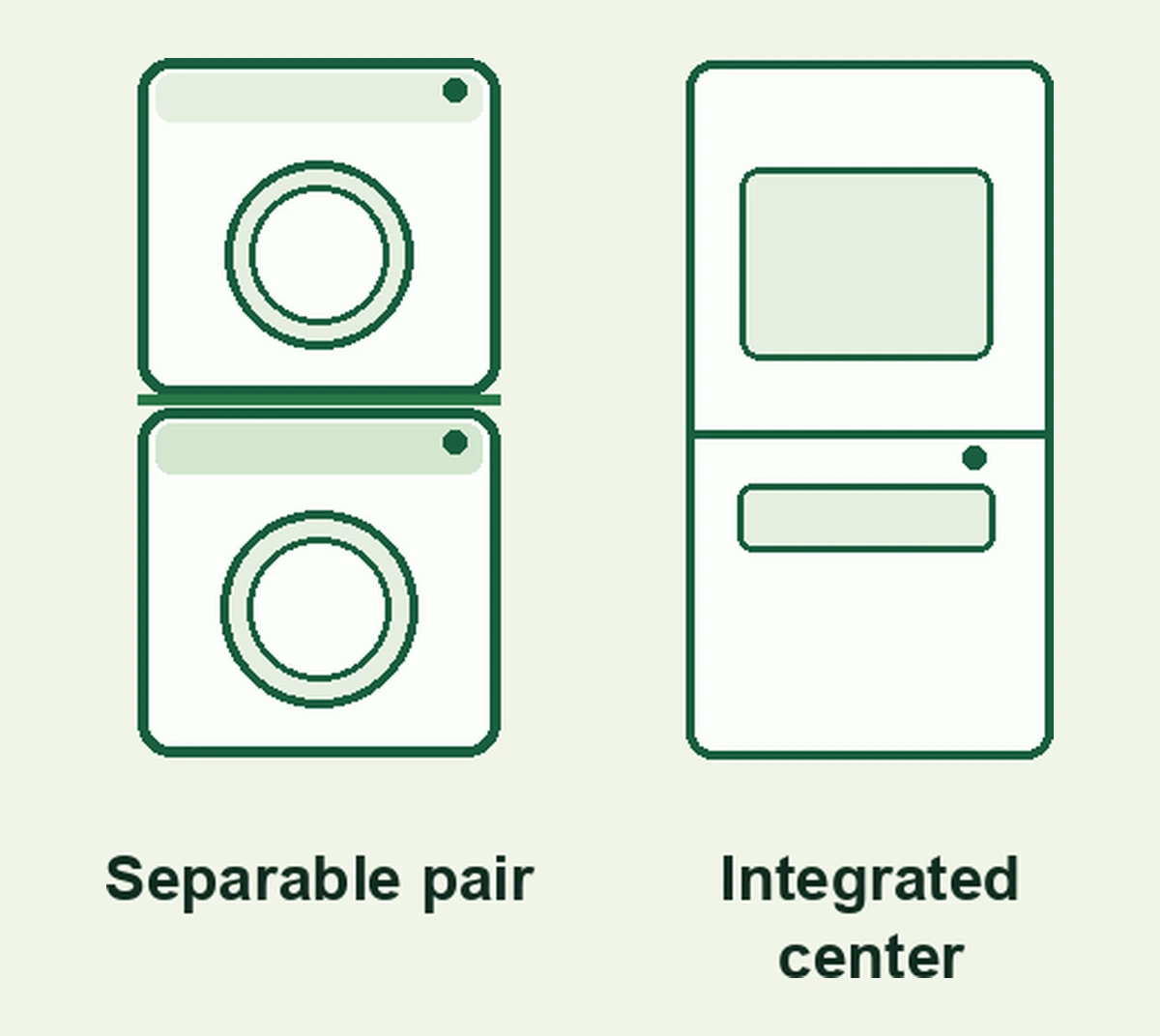
A stackable pair uses two distinct machines in a manufacturer-approved configuration. A one-piece laundry center houses both machines in one unit. Compare the door and stair clearances for the equipment as delivered, the position of controls, and how each option would be serviced if one part stopped working.
For most renters or homeowners, the decision comes down to space, installation access, and how you want to handle repairs or replacement. Each type has specific model labels, installation routes, and service considerations. Below, you’ll find a detailed look at these factors and a realistic example to help you make the best choice for your situation.
| Check | What to verify |
|---|---|
Laundry center | Check one-piece delivery size |
Stackable pair | Confirm model compatibility |
Service | Ask how issues are handled |
Definitions: Stackable Washer and Dryer vs Laundry Center
A stackable washer and dryer refers to two independent appliances, one washer, one dryer, designed to be placed on top of each other. Usually, the washer is installed below and the dryer above. These are full-featured machines, often with their own controls, service needs, and model numbers. They can also be installed side by side if space allows.
A one-piece laundry center is a single, vertically oriented appliance. The washer (usually a top-loader) sits at the bottom, and the dryer is fixed above. The controls for both are generally placed on a single console. Laundry centers are manufactured and sold as a unit. you cannot separate the two components.
The key distinction: stackable washer and dryer sets are two separate machines, while a laundry center is a single, unified appliance.
Installation Route and Access
Stackable Washer and Dryer
Stackable sets offer flexibility during installation, especially in tight spaces like closets or smaller laundry rooms. Each machine is moved individually, which can help when navigating narrow hallways or staircases in Kansas City apartments or older homes. Because each unit is separate, you can often swap out one without disturbing the other, useful if you only need to replace or repair the washer or dryer.
Installation requires compatible hookups for both appliances. You’ll need a sturdy floor and a stacking kit specific to your models. The kit secures the dryer above the washer for stability and safety. Always verify that your machines are stackable by checking the model label or documentation, and confirm with your provider if unsure.
One-Piece Laundry Center
A laundry center arrives as a single, tall appliance. It can be less flexible to maneuver through tight spaces, especially where ceiling height or doorways are limited. Because the unit is pre-assembled at the factory, it must fit as-is from the street to your laundry area.
Hookups for a laundry center are often simpler, as the washer and dryer share a single set of connections. However, the full appliance must be removed for any major service or replacement, which can be a challenge in small apartments or basements with tight stairs. If you have questions about fit or access, check the model’s installation manual and consult with a qualified installer.
Installation Checklist
- Measure all doorways, stairs, and hallways from entry to laundry area
- Confirm ceiling height, especially for tall laundry centers
- Check for existing hookups (water, drain, vent, and power)
- Review the appliance’s installation requirements in the manual
- Ask your provider about model compatibility and stacking kits
Model Label and Identification
Stackable Washer and Dryer
Each machine in a stackable set has its own model and serial number. You’ll find these labels on the inside of the door, on the back, or near the control panel, refer to the manual for exact placement. When arranging delivery or service, you may need both model numbers, as the washer and dryer are distinct products.
When renting or buying, confirm that both machines are stackable. Some washers and dryers are not designed to be stacked and may lack the required mounting points. Providers like Robust Rentals can help you confirm model compatibility for stacking.
One-Piece Laundry Center
A laundry center has a single model number, usually located behind the washer lid, on the back, or inside the door. This label covers the entire unit, as both washer and dryer are permanently joined. You’ll only need to reference this one number for service, delivery, or troubleshooting.
If you’re comparing options, note that laundry centers are often labeled with terms like “unitized,” “laundry center,” or “combo.” Always check the manual to be sure.
Service and Maintenance Implications
Stackable Washer and Dryer
Because stackable sets are two machines, service is more flexible. If the dryer needs repair, the washer can often remain in place and continue to be used, or vice versa. When renting, this can reduce disruption, one machine may be swapped or serviced independently.
Maintenance is also straightforward. Cleaning filters, checking hoses, and running cleaning cycles can be done on each appliance as needed. If one machine is replaced, you usually do not need to uninstall both.
However, stacking does mean the dryer is higher up, which may make filter cleaning or controls less accessible for some users. If you have mobility concerns, consider whether you can comfortably reach the top appliance.
One-Piece Laundry Center
A laundry center is serviced as a single unit. If either the washer or dryer requires major repair, the entire appliance may need to be moved or disconnected. This can be more disruptive in small homes or apartments.
Routine maintenance, like cleaning the lint filter or checking hoses, is similar to separate machines, but you must follow the instructions for your specific model. If the washer or dryer becomes unrepairable, the whole unit is typically replaced.
For renters using a service like Robust Rentals, covered service is included. Still, you’ll want to consider the potential for more involved removal or replacement if the laundry center has a major issue.
Comparison: Key Choices for Renters and Homeowners
Space and Flexibility
Stackable washer and dryer sets are generally more flexible. You can choose to install them side by side or stacked, depending on your laundry room layout. Moving and replacing one machine is usually easier, which can be a benefit in multi-story homes or apartment buildings with tight access.
Laundry centers are taller and narrower, fitting well in certain closets or alcoves. However, their height can be a problem in spaces with low ceilings or overhead cabinets.
Installation and Hookups
Stackable sets require hookups for both machines. This means you’ll need to confirm water, power, and venting are in place for each. Laundry centers usually combine hookups, which can simplify installation but may limit your upgrade or replacement options later.
Service and Repairs
With stackable sets, you can address issues with one machine at a time. This is useful if you want to upgrade just the washer or dryer, or if only one needs service. Laundry centers require full-unit service, which can be less convenient if access is limited.
Controls and Accessibility
Stackable sets usually have separate controls at the top of each machine. This can put the dryer’s controls and lint filter higher up than some users prefer. Laundry centers place all controls on a single, mid-height panel, which may be easier to reach for most people.
Model Availability and Compatibility
Stackable sets are available in a wider range of capacities, features, and brands. Laundry centers tend to have fewer options and are often found in standard sizes. Always check model compatibility with your provider, especially if you’re renting and need machines that match your hookups.
Example Choosing for a Kansas City Apartment
Let’s say you’re renting a two-bedroom apartment in Kansas City with a narrow laundry closet. You measure the space and find that the closet is 33 inches wide, with a 6-foot-6 ceiling and a standard washer/dryer hookup.
You compare a stackable washer and dryer versus a one-piece laundry center. The closet is just wide enough for either, but the ceiling is a concern. You check the installation manuals (or ask Robust Rentals for model dimensions) and find that a typical laundry center may be too tall for the available space, especially if there’s an overhead shelf.
Choosing stackable machines, you can move each unit in separately, stack them using a kit, and still access the shelf for storage. If you later need to replace the dryer, you only need to remove the top unit. This flexibility makes the stackable option a better fit for your apartment’s layout and your need for easy service.
If, on the other hand, your closet is deeper and has more vertical clearance but less width, a laundry center might fit perfectly. The single control panel could be easier to reach, and the unified hookups simplify installation.
This example shows that measuring your space, checking the model details, and considering access for delivery and service are key steps. Always use the actual model’s manual or ask your provider for help with fit and installation.
Fitting Stackable Washer Dryer vs Laundry Center Into Your Home
Once you know the differences between a stackable washer and dryer versus a one-piece laundry center, the next challenge is matching the right option to your specific living situation. Many Kansas City homes and apartments have unique layouts, closet depths, and access restrictions. Here’s how to think through some less obvious but important scenarios before making a decision.
Laundry in Apartments or Condos With Tight Access
Older apartments and condos in Kansas City often have narrow hallways, tight corners, or oddly placed laundry closets. In these settings, the way a washer and dryer get into your unit matters as much as the machines themselves.
A stackable washer and dryer set comes as two separate pieces. That can make it easier to maneuver each unit through small doorways or up tricky flights of stairs. You can often tip or pivot each appliance individually, which helps if space is especially tight.
A one-piece laundry center, however, is a single tall unit. Its height and depth may be manageable in an open area but can be challenging in a building with low ceilings, sharp turns, or short closet doors. If you’re unsure whether a one-piece unit will fit, measure all doorways, stairwells, and the installation area. Compare these to the model’s listed dimensions. If you have doubts about fit or access, ask Robust Rentals for guidance or arrange a walk-through.
Choosing for Shared Laundry Spaces
If you share laundry with a housemate or family, the way you use the space can influence your choice. Two separate machines (stacked or side-by-side) let more than one person use the laundry at once, one can start a dryer load while another begins a wash. This flexibility can matter in busy households or shared rental arrangements.
A one-piece laundry center, by design, only runs one wash and one dry cycle at a time. If you have back-to-back loads to do or people with different laundry schedules, this could cause a bottleneck. However, laundry centers can be quieter and easier to operate for a single user, since all controls are in one place.
Think about your household’s laundry habits: Do you often run both machines simultaneously? Do you need to wash delicate items while drying a heavy load? If so, a stackable set could serve you better.
When Noise and Vibration Matter
Some Kansas City apartments have laundry closets close to bedrooms or living spaces. In these cases, noise and vibration become important.
Stackable washer and dryer sets vary in noise output. Some modern washers are very quiet, but older or refurbished models may vibrate more, especially if not stacked carefully. Installing anti-vibration pads or ensuring a level floor can help, but the results depend on the machine model.
One-piece laundry centers are often lighter and may vibrate less overall, but they can produce a single source of noise since the washer and dryer operate in one frame. If your building has thin walls or sensitive neighbors, check the noise ratings in the model’s manual or ask Robust Rentals about available options.
Planning for Moves and Flexibility
Renters who anticipate moving within Kansas City or rearranging rooms should consider portability and adaptability.
Stackable washer and dryer sets can be separated and moved one at a time. If you move to a place with a standard laundry room, you might even use them side-by-side. This can be a big advantage for those who expect to change addresses or want to future-proof their laundry setup.
A one-piece laundry center is bulkier as a single item. It may not fit all laundry closets or hookups in future apartments. If you’re likely to move, think carefully about the dimensions and the effort needed to uninstall and reinstall the unit.
Utility Hookup and Service Access Differences
Both types require compatible hookups and venting, but service visits can play out differently.
With stackable washer and dryer sets, a technician can troubleshoot or replace one machine without disturbing the other. For example, if the dryer stops working, the washer can still be used. Accessing controls or connections may be easier if the units are not stacked too tightly.
With a one-piece laundry center, all systems are combined. If one component fails, the entire unit may need to be serviced or removed for repair. Make sure the installation space leaves enough room to pull the unit out if needed. Always confirm model compatibility with your hookups before installation.
Worksheet: Deciding Which Laundry Setup Suits Your Space
Use this step-by-step worksheet to clarify your needs and narrow down the best choice for your home.
1. Measure Your Space
- Record the width, depth, and height of your laundry area, plus the width of every doorway and hallway the appliances must pass through.
- Write these numbers down and keep them handy.
2. Consider Your Household Needs
- How many people will use the machines?
- Do you need to run washer and dryer at the same time?
- Is the laundry area close to bedrooms or living areas?
3. Check Utility Hookups
- Do you already have the correct hookups for a washer and dryer?
- Is there enough space for venting, if required?
- If unsure, ask your landlord or Robust Rentals for a compatibility check.
4. Think About Future Moves
- Are you likely to move in the next year or two?
- Would flexibility to separate and move the units be helpful?
5. Service and Maintenance Considerations
- Is your laundry area easy for a technician to access if repairs are needed?
- Would you prefer the ability to use one machine if the other needs service?
6. Add Up Your Preferences
Give yourself a point for each “yes” below:
- Do you want the ability to run washer and dryer separately?
- Is moving or rearranging laundry equipment likely in your future?
- Is space tight, but you can get two separate units into the room?
- Do you want easier access for repairs?
If you score 3 or more, a stackable washer and dryer might suit you better. If you score 2 or fewer, a one-piece laundry center could be a simpler fit.
Example Scenario: Matching Laundry to a Kansas City Apartment
Imagine you rent a third-floor apartment in an older building near Midtown Kansas City. The laundry area is a closet off the hallway, with a standard door and a 90-degree turn from the front door. You measured and found the closet is 33 inches wide, 31 inches deep, and 75 inches high. The hallway is 32 inches wide.
You live alone and do laundry once a week. You rarely need to run two loads at the same time. You plan to stay in this apartment for at least a year.
A stackable washer and dryer set might be easier to get through your narrow hallway and closet door, since each machine can be moved separately and stacked once inside. However, a one-piece laundry center, if it matches your closet’s height and depth, could also fit. You’d need to compare the model’s exact measurements with your space.
If you’re unsure, contact Robust Rentals with your measurements. They can help check if their models will fit through your hallway and into your closet, and confirm if your hookups match. Always review the model label and manual before installation.
Frequently Asked Questions
What’s the biggest advantage of a stackable washer and dryer?
Flexibility. You can move and install each piece separately, use them side-by-side if space allows, and continue using one if the other needs service.
Does a one-piece laundry center save more space?
It can, but only if your closet or laundry area matches its footprint. Always compare actual model dimensions with your available space.
Can I install either type myself?
No. Use a qualified professional or the installation service provided by your rental company. Unverified hookups or improper installation can lead to leaks, noise, or damage.
How do I know if my hookups are compatible?
Check with your landlord or Robust Rentals before delivery. They can confirm if your water, drain, and power connections match the model you’re considering.
What happens if my rental machine breaks down?
If you rent from Robust Rentals, covered service is included. Contact them for repairs or troubleshooting. Keep your rental agreement and model information handy for quick reference.
Your Next Step
Measure your laundry area, hallways, and doorways. Write down your household’s laundry habits and future plans. Then contact Robust Rentals or your chosen provider with your details. Share your measurements and needs to get personalized guidance on the best laundry option for your space. This ensures a smoother installation and a better fit for your home.
Rental options and related guides
See current washer and dryer rental options
Measure the laundry closet and delivery route · Check apartment washer and dryer hookups